

Quick answer: Talk about change as a pattern, not a verdict
When people first notice spiritual awakening signs, the most common slip is treating each feeling, dream or coincidence as proof of something definitive. A better approach is to talk about change as a pattern across weeks and months, not as a single moment that explains everything. Describe what shifted, what stayed, what you tested and what you are still unsure about. This keeps the conversation useful for the people around you and honest about your own experience.
The aim is not to dilute your experience. It is to make it shareable. If you tell a friend, "I have felt less reactive in traffic for about six weeks, and I am not sure why," that invites discussion. If you say, "I woke up, and now nothing bothers me," you close the door on nuance and make it harder for anyone to compare notes. Spiritual change is real, but it travels through ordinary life — tiredness, stress, grief, good days and ordinary Wednesdays — and that is where it deserves to be talked about well.
What this guide covers
- Why we turn feelings into signs, and how to notice it
- A way to describe spiritual change without claiming more than you know
- A comparison of three common ways people talk about awakening
- A decision process for choosing what to share, and with whom
- The most frequent mistakes, and what to do instead
- How clothing and activism fit in without becoming props
- A short FAQ
- A dated update note at the end
Why the impulse to read signs is so strong
There is a sensible reason people reach for spiritual awakening signs. Inner change can be difficult to point at. You cannot show someone a certificate for feeling less attached to being right in an argument. You cannot photograph the moment a long-standing fear lost its grip. Because the evidence is invisible, people reach for visible markers: a number on a clock, a feather, a song on the radio, a synchronised meeting.
These markers can be genuinely meaningful to you. The problem begins when they are presented as universal meanings or as proof of a stage you have reached. A repeated number may feel significant because you noticed it; it does not mean the same thing for everyone reading your post. A strong emotion during meditation may be a release, or it may simply be fatigue. The honest position is to say what you experienced and leave the interpretation open.
A navigation list: Six ways to keep the conversation grounded
- Speak in timeframes, not moments — "over the last two months" rather than "at 3:33 this morning."
- Separate the experience from the meaning — describe what happened before you claim to know why.
- Name what you are still unsure about, especially with people newer to this than you.
- Avoid presenting personal symbolism as if it were a shared code.
- Let other people disagree without treating it as resistance to your growth.
- Keep products, practices and actions in a supporting role, not the headline.
Three ways people talk about spiritual change
| Approach | What it sounds like | Strengths | Risks |
|---|---|---|---|
| Verdict style | "This dream means I have cleared my throat chakra." | Feels decisive and shareable. | Turns one experience into a claim; hard to revise later. |
| Catalogue style | "Here are twenty signs you are awakening." | Easy to read, easy to search. | Encourages matching feelings to lists rather than observing yourself. |
| Pattern style | "Over three months I noticed I argue less, sleep differently and care less about being right. I am still working out why." | Honest, revisable, invites real conversation. | Slower; less dramatic; needs patience. |
The pattern style is the one this guide recommends. It is not more spiritual than the others; it is simply more accurate, and accuracy protects the people around you from feeling they are failing some invisible test.
A decision process for what to share
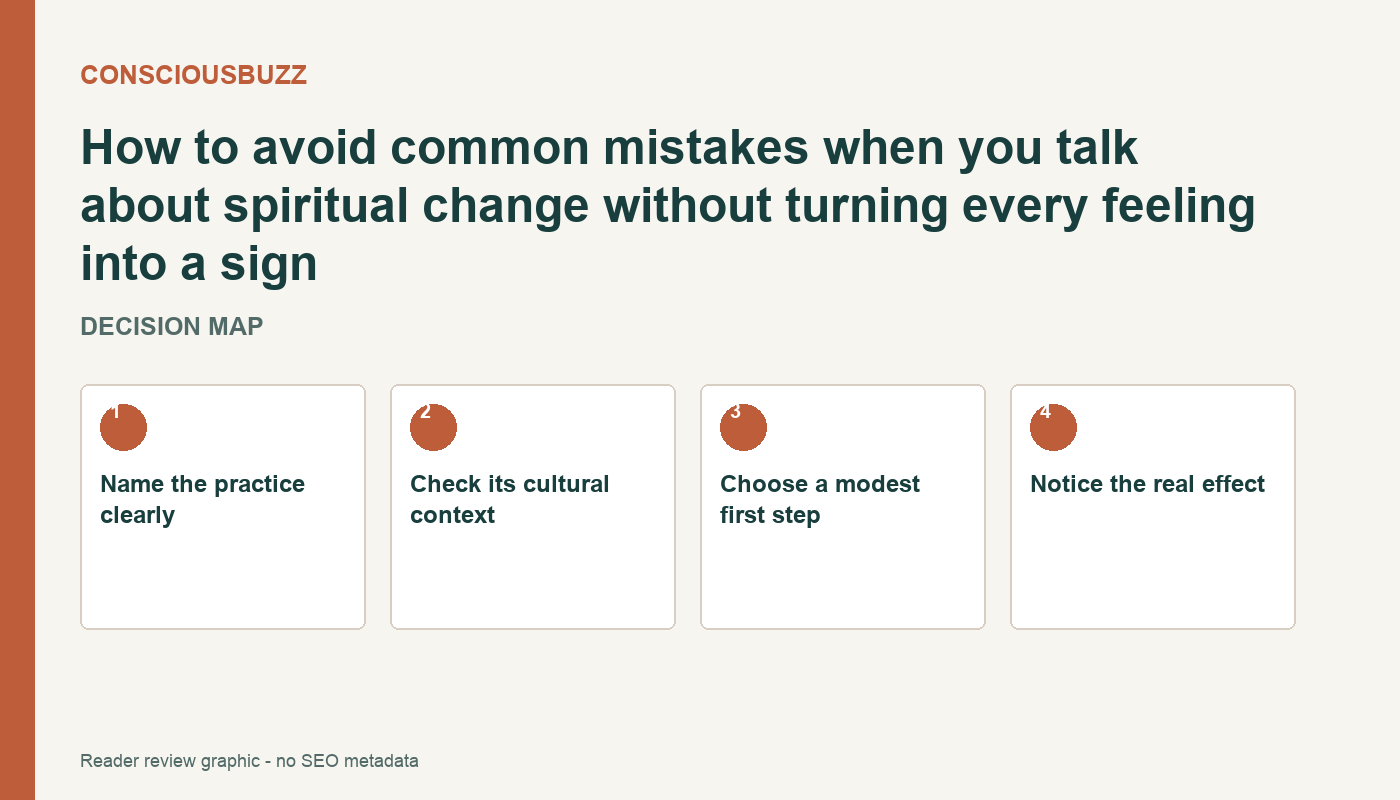
When something feels like a sign, run it through a short decision process before you speak or post about it.
Step 1 — Notice. Write down what actually happened, in plain language. Not "I received a message," but "I thought of an old friend and they texted the next day."
Step 2 — Wait. Give it at least a few days. See whether the feeling stays, fades or links to something else entirely.
Step 3 — Check the pattern. Ask whether this fits a longer change in your life or stands alone. A single moment can be moving without being evidence of a stage.
Step 4 — Choose your audience. A close friend, a journal, a small group or a public post are different contexts. What is appropriate in one may be too much in another.
Step 5 — Share the experience, not the verdict. Talk about what you noticed and how you are interpreting it, while leaving room to be wrong.
This process does not make the experience smaller. It makes it sturdier. You are more likely to keep learning from it if you have not already nailed it down with a label.
Common mistakes and what to do instead
Mistake: Treating every strong feeling as a breakthrough. Some feelings are grief, tiredness or relief at finally resting. Not every wave is a shift in consciousness. What to do instead: notice the feeling, name it plainly, and only revisit it as a possible sign if it recurs or changes your behaviour over time.
Mistake: Using spiritual vocabulary as a shortcut. Saying "my shadow came up" can be useful shorthand, but it can also skip over the actual content of what you felt. What to do instead: describe the situation first — who said what, what you felt, what you wanted — before reaching for the framework.
Mistake: Presenting personal symbols as universal. A number, an animal or a song can mean a lot to you and nothing predictable to someone else. What to do instead: keep the "to me" attached. "This meant something to me" is a stronger sentence than "this means awakening."
Mistake: Using clothes, rituals or purchases as evidence. Wearing a particular garment or starting a practice can support your change, but it is not proof of it. If you want to explore that support honestly, our page on spiritual clothing covers what to think about without overstating it, and our guide to the best spiritual clothing brands looks at specific makers we can recommend.
Mistake: Turning activism into a spiritual credential. Caring about the world is part of many people’s path, but it is not a badge of awakening. What to do instead: let your actions be plain and accountable. If you want a framework for this, our piece on spiritual activism as positive action sets out a nonviolent, constructive approach.
Mistake: Talking about your change in a way that makes others feel behind. If your sharing implies a hierarchy, people will either withdraw or compete. What to do instead: include your doubts and your ordinary days. They are part of the same story.
How clothing and activism fit without becoming props
Spirituality, spiritual clothing and activism are easy to talk about badly because each can be seen from the outside. A jumper with a line of Sanskrit, a march attended on a Saturday — these are visible in a way that inner change is not. That visibility is useful, but it is also a trap if it starts to stand in for the change itself.
Clothing can be a daily reminder of an intention. It can support a small producer. It can start a conversation. What it cannot do is prove anything about your inner state, and any brand that implies otherwise is overstepping. Wear what helps you stay honest, not what helps you perform.
Activism has the same shape. It is most powerful when it is consistent, specific and kind. A cause you turn up for three times a year, in a way that is accountable to the people affected, is worth more than a loud declaration of your spiritual alignment. Keep the doing ahead of the describing.
A review checklist for spiritual awakening signs
Use this checklist every few weeks to keep your language and practice honest:
- Have I described change in timeframes rather than single moments?
- Have I separated what happened from what I think it means?
- Have I left room to be wrong, in public and in private?
- Have I avoided claiming universal meaning for personal symbols?
- Are the clothes, practices or causes I mention supporting the change, or standing in for it?
- Have I checked whether my sharing makes others feel included or ranked?
- Is there anything I would now revise, repeat or stop?
If you can answer these without flinching, your conversation about spiritual change is probably in good shape.
FAQ
Is it wrong to notice signs? No. Noticing is the point. The difficulty is when noticing becomes claiming. You can stay curious without concluding.
How do I talk about awakening with people who are sceptical? Lead with behaviour, not labels. Say what you have noticed in yourself and what you are trying out. Sceptics respond well to honesty about uncertainty.
Do I need to buy anything to talk about this well? No. Products can support practice, but they are not required and they are not evidence. Anything we recommend sits behind the value of the conversation, not in front of it.
What if a sign keeps repeating? Take it seriously as something worth sitting with. Write down what is actually happening in your life at the same time. The pattern may be the message, not the symbol.
Can activism be part of spiritual change? Yes, when it is honest, nonviolent and accountable. It is not a certificate of awakening, and it works best when the action matters more than the announcement.
Update note
Updated September 2026: Refined the decision process and checklist to make them easier to use in conversation, and clarified the section on clothing and activism so neither is presented as evidence of inner change. If you would like fewer loud takes and more careful notes like this, you can join the ConsciousBuzz email list for occasional updates — no urgency, no promises of transformation, just considered writing when there is something worth sending.