

Updated September 2026
Start with meaning, context, and repeat wear
Spiritual clothing is everyday clothing chosen for a symbol, message, material, or personal reminder. It is not automatically religious dress, and a symbol does not have one universal meaning. Before buying or wearing a piece, learn where the symbol comes from, check whether it belongs to ceremonial use, and ask whether the garment works in your real wardrobe.
Looking for clothing to buy? Browse our men’s clothing or women’s clothing, then check the individual product’s fabric, size guide and care instructions. For help understanding a design before choosing it, use the sections below on meaning, symbols and everyday wear.
- What is spiritual clothing?
- Spiritual clothing meaning and how people read it
- Spiritual style vs. religious or ceremonial dress
- Common symbols and what they can represent
- How to choose spiritual wear for everyday life
- Spiritual streetwear as casual expression
- Materials, fit, and comfort
- How to wear spiritual symbols respectfully
- A practical comparison of approaches
- Decision process: picking a piece step by step
- Common mistakes to avoid
- FAQ
What Is Spiritual Clothing?
Spiritual clothing is a loose category. It covers garments people choose because the design, text, symbol, color, or sourcing expresses something they hold as meaningful on a personal or contemplative level. A hoodie printed with a lotus, a tee referencing a meditation line, a natural-fiber tunic chosen for simplicity, or a jacket carrying a hand-drawn mandala can all sit in this space.
The defining trait is intent rather than a required dress code. Someone may wear the same plain linen shirt because it reminds them to slow down, while another person wears a graphic tee that quotes a teacher they respect. Neither garment has a fixed spiritual function. The wearer gives it one within limits of respect and accuracy.
This is where spiritual clothes overlap with but are not identical to spiritual wear from brands that build their whole catalog around contemplative themes. Commercial spiritual wear can be part of a personal practice, but the category also includes thrifted, handmade, and plain pieces chosen for their felt meaning.
Spiritual Clothing Meaning and How People Read It
Spiritual clothing meaning is not stable across wearers. The same printed eye can read as protection to one person, as decoration to another, and as a reference to a specific folk tradition to a third. Treating any single meaning as universal tends to flatten the symbol and, worse, misrepresent the tradition it came from.
A more honest approach is to think of meaning on three layers:
- Personal layer: what the piece reminds the wearer of, such as a commitment, a memory, or a value.
- Cultural layer: what the symbol actually refers to in the tradition it comes from, including rules about who may use it.
- Public layer: what strangers are likely to assume when they see it, which may or may not match the first two.
When these layers conflict, the public layer usually wins in daily life. A sacred diagram worn as a fashion print may still read as appropriation to a member of the source community, even if the wearer’s private intention is reverent. That gap is what makes respectful use worth thinking through before buying.
Spiritual Style vs. Religious or Ceremonial Dress
Spiritual style is self-selected. Religious and ceremonial dress is usually governed by a community, a lineage, or a recognized authority, and often tied to initiation, role, or occasion. Mixing the two causes most of the friction around this kind of clothing.
Garments such as a monk’s robe, a nun’s habit, a tallit, a clerical collar, or specific ceremonial vestments are not spiritual streetwear. They mark belonging and responsibility within a tradition. Wearing them outside that context is a different act than wearing a tee with a general contemplative print, and it carries weight the wearer did not earn by buying it.
Guidance from interfaith organizations on religious dress and accommodation tends to distinguish required or symbolic religious garments from personal style choices, and that distinction is useful here. Spiritual clothes borrow themes and motifs; they do not replace or mimic office-holding garments.
Common Symbols and What They Can Represent
Symbols used on spiritual wear carry different histories. None of them has a single fixed meaning that transfers automatically to a printed shirt. A short overview:
- Lotus: in several South and East Asian traditions, associated with purity, awakening, or growth through difficult conditions. On apparel it often reads as a general contemplative motif.
- Mandala: used as a focus for attention and as a representation of structure in particular Tibetan and related practices. Printed versions are usually decorative rather than ritual.
- Om: a sound and written form with specific roles in Hindu, Jain, and Buddhist contexts. Its use on casual clothing is sometimes contested.
- Eye motifs: appear across many cultures with differing functions, from protection to awareness. Meaning depends heavily on the exact form and source.
- Trees, roots, mountains: broad nature symbols that tend to read as groundedness without belonging to one tradition.
- Text quotes: lines from teachers, poets, or scriptures. These can be the most respectful option when chosen carefully, and the most misleading when quoted out of context.
If you want depth without overclaiming, broad nature symbols and your own short text tend to cause the least friction. Highly specific ritual diagrams are the riskiest for casual wear.
Why source matters more than symbol
A symbol’s effect on others depends less on the shape than on who made it, where the file came from, and whether the brand explains its use. A mandala redrawn by an artist who studies the tradition reads differently from one scraped from a stock site. Checking a brand’s about page is a fast filter.
How to Choose Spiritual Wear for Everyday Life
Most spiritual clothes fail as everyday wear for the same reasons any clothes fail: bad fabric, weak printing, awkward fit, or a graphic that only works in one context. Pick for wearability first, then meaning.
Practical filters that tend to work:
- Can you wash it normally? Heavy spiritual prints often crack or fade. Check care instructions.
- Does it layer? A piece that works under a jacket or over a plain tee has more use than a loud statement piece.
- Does the graphic read at conversation distance? Tiny text frustrates people; huge text can feel aggressive.
- Can you wear it to work, family events, or travel? If not, it lives in a drawer.
- Do you know what the symbol references? If not, either learn it or choose something else.
For a broad catalog aimed at men’s cuts, you can browse spiritual clothing for men to see how motifs translate into everyday silhouettes. The same filters apply regardless of section.
Spiritual Streetwear as Casual Expression
Spiritual streetwear takes contemplative motifs and puts them into hoodies, tees, caps, and oversized cuts drawn from skate and street culture. It works because those formats are already casual, washable, and built for movement. The risk is that streetwear’s visual loudness can flatten a symbol into a logo.
Where streetwear excels: layered outfits where one piece carries the motif and the rest stays quiet. A printed hoodie over plain trousers reads as intentional. The same hoodie stacked with a matching cap, tote, and printed pants usually reads as costume.
If you want a single strong piece in this style, spiritual hoodies cover the most common cut. Treat the hoodie as the anchor, not the whole outfit.
Materials, Fit, and Comfort
Comfort is the underrated half of spiritual wear. A piece that scratches, traps heat, or restricts breathing will not get worn, and an unworn garment carries no meaning. Fabric choice also affects how prints age.
- Cotton and cotton blends: the default for printed tees and hoodies. Soft, washable, predictable. Mid-weight tends to outlast thin or very heavy options.
- Linen: good for warm weather and a simpler look. Wrinkles easily, which some people read as relaxed and others as unkempt.
- Hemp blends: durable and often associated with lower-impact sourcing, but heavier hand and less softness until broken in.
- Recycled and organic cotton: can reduce certain impacts compared to conventional cotton, but do not assume ethics from the label. Look for named certifications.
On fit, oversized cuts suit streetwear-leaning pieces; regular or tailored fits suit pieces meant to layer into work or travel wardrobes. Choose based on where you actually plan to wear the garment, not on the model photo.
How to Wear Spiritual Symbols Respectfully
Respectful use is a practice, not a checklist you complete once. The aim is to reduce harm to the communities a symbol comes from while keeping room for genuine personal expression.
A workable approach:
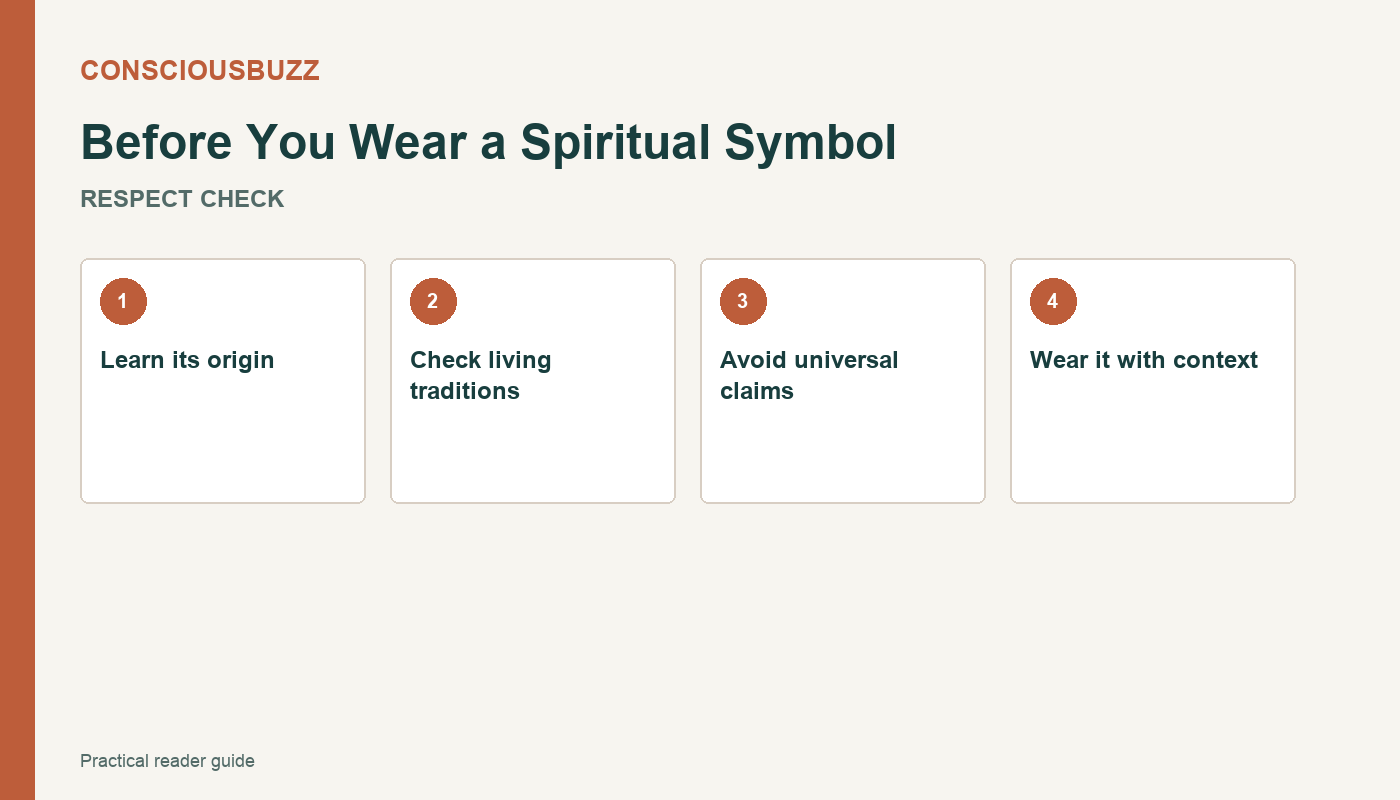
- Learn the symbol’s origin, its ordinary use, and any restrictions on who may wear it.
- Avoid garments that replicate ritual objects, scripture verses meant for ceremony, or insignia of office.
- Prefer designs by artists from the tradition, or brands that explain their source and credit collaborators.
- Read the text before printing it. Misquoted or mistranslated sacred text is worse than no text.
- If a member of the source community tells you the use is harmful, take the correction seriously rather than defending the purchase.
Museum collections show how cloth can carry religious, political, and communal meaning as well as decoration. The Victoria and Albert Museum’s overview of Indian textile traditions is a useful reminder that a fabric or motif may carry a history far deeper than its modern decorative use. The point is not to ban every cross-cultural influence. It is to learn enough context to avoid turning a meaningful sign into an empty graphic.
A Practical Comparison of Approaches
Different approaches to spiritual clothing trade off meaning, comfort, and social risk differently. The table below compares four common routes.
| Approach | Everyday wearability | Meaning clarity | Respect risk | Best for |
|---|---|---|---|---|
| Plain natural-fiber basics chosen for intention | High | Private, low visibility | Very low | People who want meaning without display |
| Quote or short text on a tee | Medium-high | Clear if quote is accurate | Medium, depends on source text | Readers, writers, teachers’ students |
| Broad nature symbol on hoodie | High | General, open | Low | Layered streetwear outfits |
| Specific ritual diagram or sacred script | Low-medium | High for those who know it | High unless from a credited source | Practitioners within the tradition |
For everyday use, the first three rows cover most people. The fourth is best left to those with a real connection to the source practice.
Decision Process: Picking a Piece Step by Step
A simple process keeps buying decisions honest and avoids drawers full of unworn graphic tees.
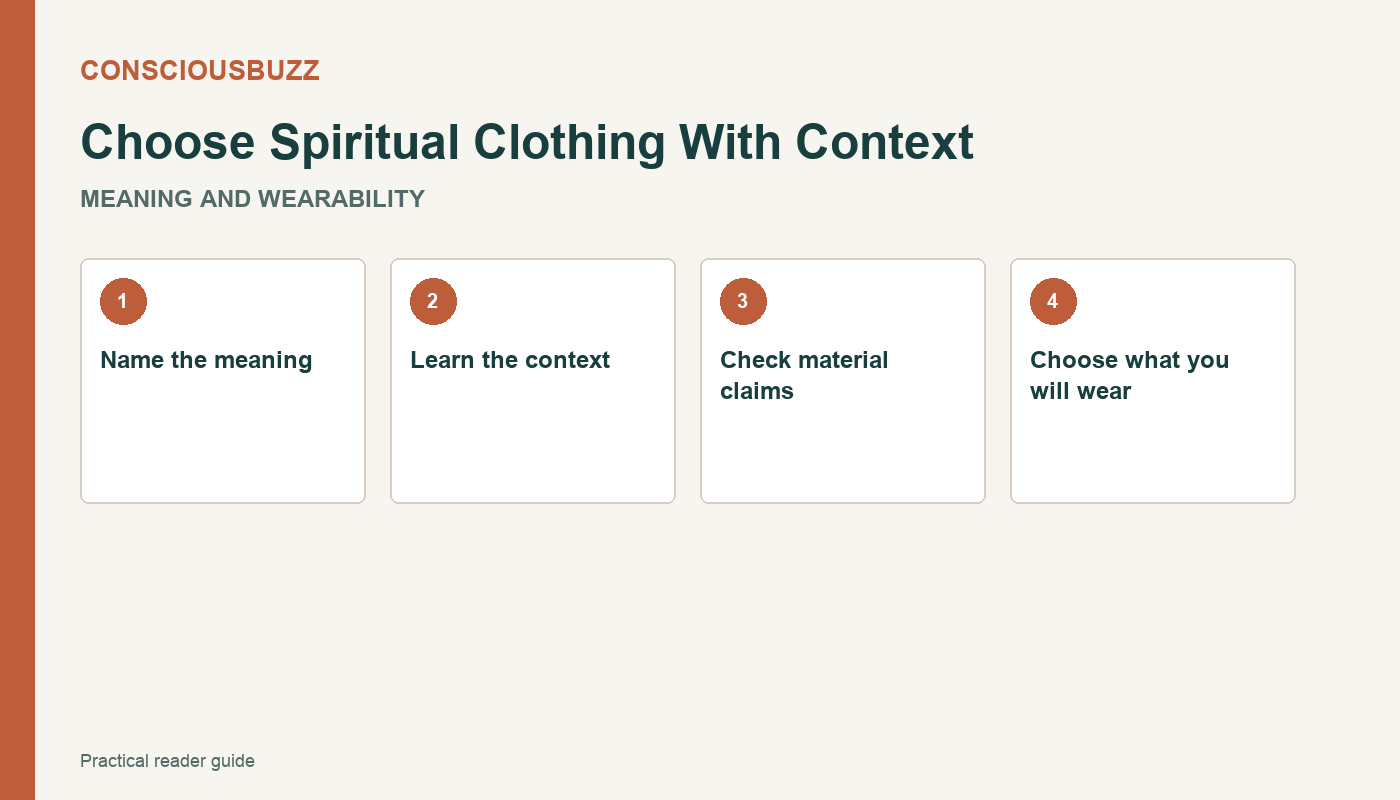
- Name the meaning you want. A daily reminder? A community signal? Comfort on retreat? Be specific.
- List where you will wear it. Work, weekends, travel, practice space. Each setting limits fit and loudness.
- Shortlist symbols that match the meaning. Prefer broad ones unless you have a specific tie to a tradition.
- Check the source. Read the brand page. Look for artist credit, tradition notes, and any certification claims.
- Confirm fabric and care. Match the weight to your climate and the care to your habits.
- Check the public layer. Imagine a stranger from the symbol’s source culture seeing it. If that feels uncomfortable, choose differently.
- Buy one piece first. Wear it for a month before adding more. Most people find one or two pieces are enough.
If you want to extend the idea beyond apparel into action, spiritual activism and positive action covers how values translate into doing rather than only dressing.
Common Mistakes to Avoid
- Treating symbols as universal. A lotus is not a generic flower. Context changes what it means and who can use it casually.
- Buying for the photo, not the wardrobe. Pieces styled for product shoots often fail in real outfits.
- Assuming organic means ethical. A fiber claim is not a labor or supply-chain claim. Read further.
- Stacking many symbols at once. One strong piece reads as intention; five read as decoration.
- Mimicking religious or ceremonial dress. Robe-like cuts, ritual vestments, or office insignia belong to their traditions.
- Quoting without checking. Misattributed lines spread fast. Verify the teacher and the wording.
- Ignoring climate. Heavy hoodies in humid summers stay in the closet. Match weight to where you live.
FAQ
Is spiritual clothing the same as religious clothing?
No. Religious clothing is usually governed by a community and tied to role, ritual, or belief requirements. Spiritual clothing is self-selected personal expression that may borrow motifs but does not replace governed religious dress.
Can anyone wear a lotus, om, or mandala?
It depends on the symbol, the form, and your relationship to the source tradition. Broad nature symbols are usually low friction. Specific ritual forms, sacred script, and office insignia are higher risk and best left to practitioners or credited artists from the tradition.
Does spiritual clothing have a spiritual effect?
No garment produces a spiritual effect by itself. Meaning comes from the wearer’s intention and practice, and from how others read the symbol. Claims that a print or fiber will protect, heal, or awaken are marketing, not teaching.
How do I find pieces that suit women’s fits?
Look for cuts designed for women’s bodies rather than unisex defaults. You can browse spiritual clothing for women for options, then apply the same fabric, care, and symbol filters.
What if I only want subtle spiritual wear?
Choose plain natural-fiber pieces in colors you respond to, or text quotes small enough to read only up close. Meaning does not require display.
Are expensive brands more respectful?
Not automatically. Price can reflect smaller runs and credited artists, but it can also reflect marketing. Check the about page and any claims, regardless of cost.
Start With One Honest Piece
Pick one garment you will actually wear for a season, choose a symbol you can explain in two sentences, and skip anything that mimics religious or ceremonial dress. That keeps spiritual clothing useful rather than performative. If you want a starting point, pick a single hoodie or tee from a brand that credits its sources, and build from there only if the first piece earns its place in your week.