
A quick answer first
Fashion activism is the deliberate use of dress — colours, fabrics, slogans, silhouettes, or the refusal of certain garments — to make a political position visible without anyone having to read a manifesto or attend a rally. It has worked through history because clothing is public, portable and unambiguous: a single colour on a single day can turn a crowd into a statement. From the handspun khadi of India’s independence movement to the pink knitted hats of the 2017 Women’s March, the garment has often arrived before the speech and stayed in the photograph long after the speech was forgotten.
The mechanism stays consistent even when the causes change. A piece of clothing is chosen, repeated by a group, recognised by observers, and read as a stance. What shifts is the context: who wears it, who is forbidden from wearing it, and what the wider public already understands about the colour or cut.
How this guide is organised
If you want to work through the topic rather than skim, the sections below build on each other:
- A quick answer and the underlying mechanism
- Five historical scenes where clothing did the political work
- A comparison of common forms of political dress
- A decision process for choosing how to wear your own values
- Mistakes that quietly weaken the message
- Frequently asked questions about fashion activism
- How this page is kept current
- A closing note and where to go next
Five scenes where the garment did the talking
A handful of examples show the range of what fashion activism can do — and the trade-offs each approach carries.
Suffrage palettes. The British and American suffrage campaigns used distinctive colour schemes — purple, white and green in Britain; purple, white and gold in the United States — so that marchers could be identified at a glance. Wearing the colours on an ordinary working day, not just at a rally, turned private sympathy into a public count.
Handspun khadi. Gandhi’s promotion of handspun, handwoven khadi was simultaneously an economic boycott of British mill cloth and, for many wearers, a spiritual discipline. The rough texture and visible handwork made the politics tactile: you could feel the refusal of empire in the fabric against your skin.
Black berets and leather. The Black Panther Party’s uniform of black berets and leather jackets borrowed visual grammar from earlier revolutionary movements and used it to mark disciplined organisation. The look photographed well and was unmistakable in print, which mattered at a time when mainstream coverage was hostile.
Quilt panels and T-shirts. The NAMES Project AIDS Memorial Quilt and the ACT UP "Silence = Death" T-shirt used domestic and reproducible forms — quilting, screen printing — to make grief and anger legible at a scale that did not require a stage.
Pink hats and high-vis vests. The 2017 Women’s March produced a sea of pink knitted hats, hand-made at kitchen tables and then mass-duplicated. Around the same period, the French gilets jaunes took the opposite route: a mass-produced safety garment already in many car boots, repurposed as a uniform of protest.
Each example shows a different trade-off. Khadi was a discipline and a sacrifice; a printed T-shirt is fast and copyable. A knitted hat is warm and personal; a high-vis vest is ready-made and indifferent to taste. Choosing one is also choosing what you will and will not say.
A comparison of common forms of political dress
| Form | How it carries meaning | Strengths | Trade-offs |
|---|---|---|---|
| Colour scheme | Repeated use of two or three shades | Reads instantly in photographs | Colours can be co-opted or lose meaning |
| Slogan garment | Text printed, embroidered or worn as a badge | Direct and unambiguous | Dates quickly; can feel loud |
| Handmade uniform | Garments made by the wearer or community | Embodies labour and commitment | Slow to produce; size and skill limit reach |
| Boycott or refusal | Choosing not to wear a contested fibre or brand | Avoids spectacle; durable over time | Less visible to outsiders |
| Religious or spiritual clothing | Robes, veils, prayer shawls worn as public witness | Carries centuries of layered meaning | Easily misread outside the community |
For more on how spiritual clothing can sit alongside political witness rather than replace it, the guide at https://consciousbuzz.com/spiritual-clothing/ unpacks the distinction in more detail.
A decision process for wearing your values without performing them
If you want to use clothing as part of a practice rather than a one-off gesture, a short sequence helps:
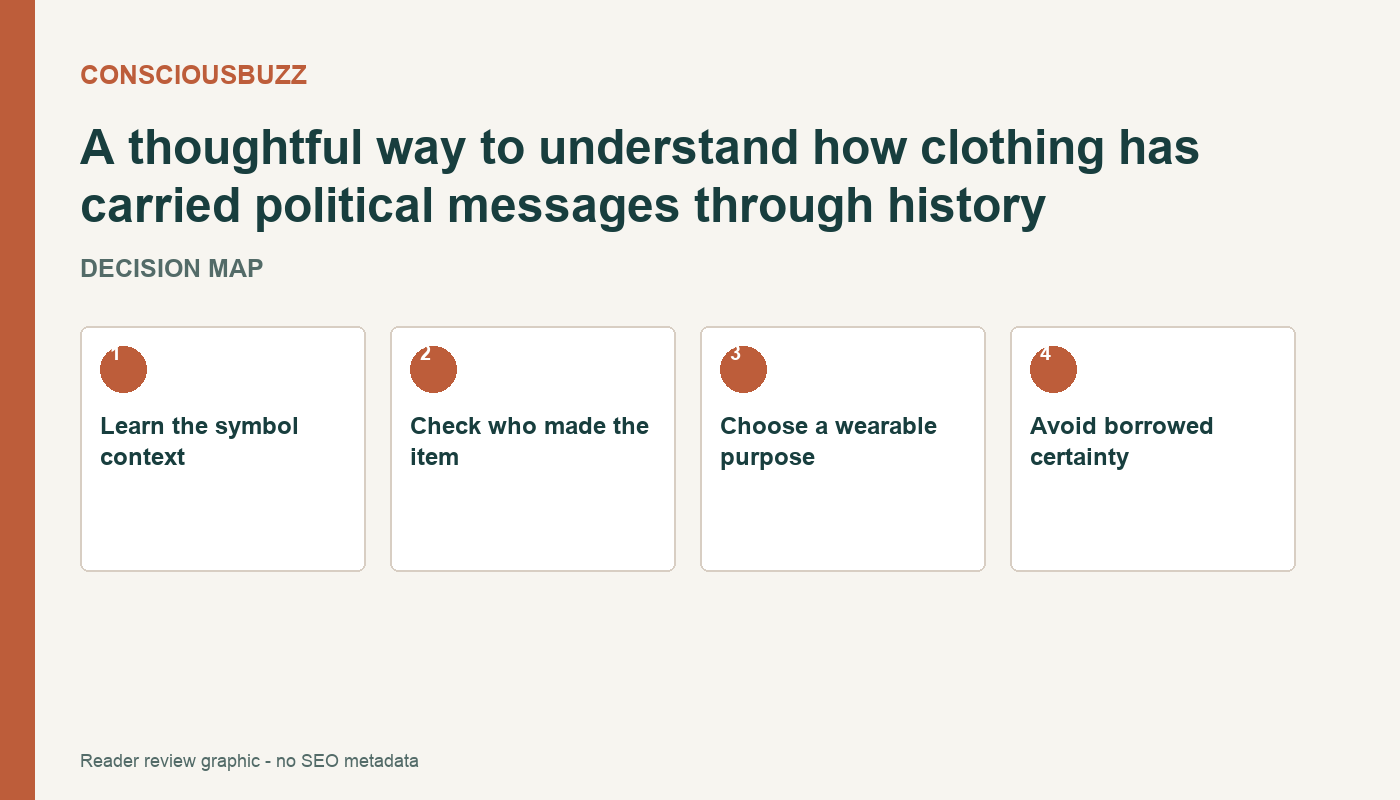
- Name the position you are trying to make visible. A single sentence is enough. If you cannot say it in one sentence, the garment will not say it either.
- Decide what the garment has to survive. A march, a workplace, a place of worship, a photograph — each asks something different of the fabric and the wearer.
- Choose the level of permanence. A pin is removable; a tattoo is not. A wardrobe purge lasts; a slogan tee lasts until the next wash.
- Check what the symbol already means. Colours and cuts travel. A white poppy means one thing in Britain and something different elsewhere.
- Be honest about who made the garment. The politics of the message and the politics of the supply chain are not separate conversations.
- Plan what you will do when it is read wrongly. Misreading is not an attack; it is the cost of working in a public medium.
This is not a recipe for correctness. It is a way of reducing the gap between what you mean and what the street reads.
Mistakes that quietly weaken the message
- Treating the slogan as the message. Words on a chest are read in under a second; they are a flag, not an argument. Pair the garment with a willingness to explain.
- Wearing a symbol you cannot source. If the colour, fibre or motif comes from a community you do not belong to, the borrowing can undo the politics.
- Assuming visibility equals impact. A photograph of a crowd in matching colours is powerful and also easy to dismiss as theatre. Match the visual with a follow-on action.
- Forgetting that dress codes are themselves political. Schools, workplaces and courts enforce dress codes; choosing to break one is not neutral.
- Overestimating your own consistency. A garment worn once is a moment; the same garment worn for a year is a stance.
- Collapsing spirituality into marketing. Sacred motifs on a sale rack are the clearest way to hollow out both the practice and the protest.
Frequently asked questions
Is fashion activism a modern invention? No. The phrase is recent, but the practice predates the printing press. Sumptuary laws, religious vestments, mourning dress and revolutionary cockades all used clothing to mark where a person stood before they said a word.
Does wearing a cause make any material difference? It can, when paired with money, time or refusal. On its own, a garment is a signal; combined with a sustained action it becomes part of a campaign.
Can spiritual clothing and political action sit together without one exploiting the other? It is possible but it takes care. Some traditions teach that dress is a private discipline, not a public performance. The guide to spiritual activism and positive action works through how to keep the two honest to each other.
What about brands that sell political clothing? A label printed with a slogan is not the same as a commitment. If you want to support makers whose practice matches their language, the spiritual clothing brands guide is a steadier starting point than a hashtag.
Is there a risk of cultural appropriation? Yes, and the risk is highest where the symbol is sacred. The safe rule is the slow one: if you cannot name the community a symbol belongs to and what it costs them to see it worn casually, leave it alone.
How this page is kept current
Last reviewed and updated on 5 September 2026. New examples are added as they become widely documented; older examples are kept because the mechanisms they show have not changed.
A closing note and where to go next
Clothing carries political messages because it is the medium we already wear to the shop, the temple, the march and the office. The work is not to invent a new language but to notice the one already in use and to use it with care. The fashion activism guide continues that analysis. If a quieter, longer approach to spirituality and constructive activism is what you are after, the ConsciousBuzz newsletter collects considered pieces on respectful dress and nonviolent practice into one short email roughly once a month. You can join the ConsciousBuzz list without urgency or slogans, as a steady companion to wearing what you mean.