
The quick answer
If you’re wondering how to be spiritual in a way that’s genuinely yours, the honest starting point is a small set of questions, not a borrowed routine. Ask: what am I actually drawn to? What am I trying to feel or understand? What practices, objects or habits fit the life I already have? And what am I willing to change — or leave alone — to make room for them?
Spirituality works best when it grows out of your own attention. A teacher, a book or a garment can point you somewhere, but the practice has to fit your context, your body and your everyday commitments. Before you adopt any ritual, wardrobe change or activism framework, spend a week simply noticing what already feels meaningful to you. That noticing is the first real practice.
What you’ll find in this guide
This article walks through a set of questions that help you build a spiritual life without copying someone else’s practice. It covers:
- Why copied practice tends to frustrate people
- A comparison of borrowed practice versus practice built from your own attention
- A step-by-step decision process with a worked example
- Common mistakes to avoid
- How spiritual clothing and constructive activism fit in without becoming performance
- A short FAQ and an update note
Why copying spiritual practice often leads to frustration
Most of us encounter spirituality through someone else’s account. A friend describes their morning meditation. A teacher explains a breath sequence. A brand sells a particular garment as "spiritual." The story is tidy and attractive, so we copy the external shape of it.
The problem is that the shape is not the practice. A morning sit that steadies one person might agitate another. A garment that carries meaning in one tradition might mean very little in your kitchen. When you copy without checking whether the practice fits your life, you tend to get one of three outcomes: you abandon it after a fortnight, you perform it for an audience, or you start to resent the practice itself.
The questions in the next section are designed to interrupt that loop. They slow the borrowing down just enough for you to notice whether a practice is actually doing something for you.
Borrowed practice vs practice built from your own attention
| What you’re considering | Borrowed practice | Practice built from your own attention |
|---|---|---|
| Starting point | What someone else says works | What you notice when you pay attention |
| Time cost | Fixed routine, often daily | Flexible, fits existing commitments |
| Evidence it’s working | External markers (streaks, group approval) | Internal shifts you can describe in your own words |
| Risk of performance | High — easy to mimic the shape | Low — the practice is tethered to your actual experience |
| Adaptability | Low — changing it feels like breaking it | High — changing it is part of the practice |
| Cost | Often includes products, retreats, subscriptions | Often free or low-cost to begin |
This isn’t an argument against learning from others. It’s an argument against skipping the step where you check whether what you’ve learned fits you.
The decision process: questions to ask before you adopt a practice
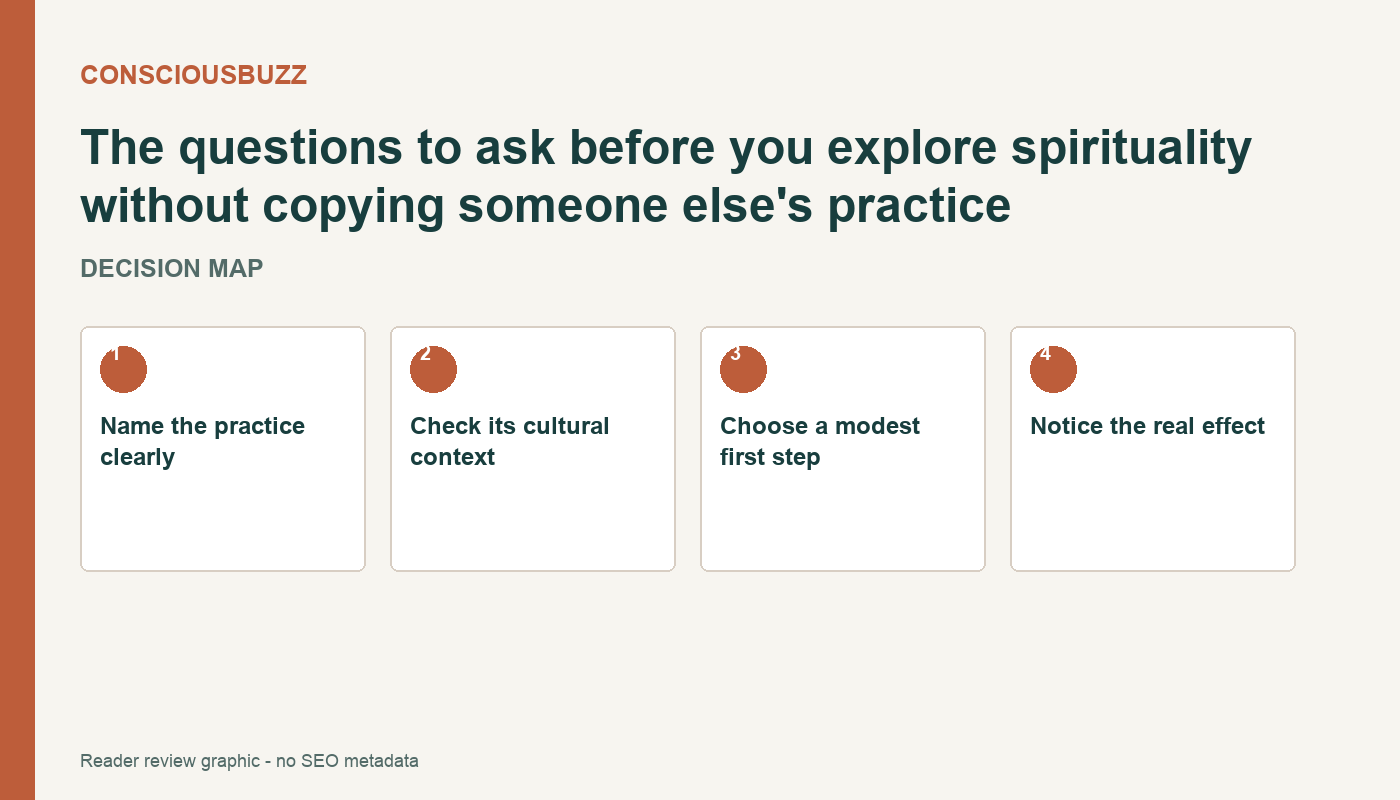
Work through these in order. Don’t rush.
- What am I actually drawn to? Not what should I be drawn to — what genuinely holds my attention? A particular kind of silence, a way of walking, a piece of music, a garment that changes how I carry myself. Note it down without editing.
- What am I trying to feel or understand? Rest? Less reactivity? Connection? A sense of meaning? Honesty about this prevents you from adopting a practice that solves a problem you don’t have.
- What already exists in my week that could hold this? A walk, a commute, the ten minutes before bed. A new practice grafted onto an existing rhythm survives longer than one bolted on.
- What would I have to stop or change to make room? If the answer is "nothing," the practice is probably too small to matter. If the answer is "everything," it’s probably too big to keep.
- Does this practice require me to buy anything, join anything or identify as anything? If it does, what’s the actual function of that purchase, group or label? Be specific. A garment might be genuinely useful or it might be a way of signalling.
- What would tell me, in a month, whether this is worth keeping? Decide the evidence before you start, in your own words. "I feel calmer" is fine. "I notice when I’m reactive and can pause" is better.
- What would tell me to stop? Give yourself permission to drop a practice that isn’t working. Continuing a practice out of guilt is the opposite of spirituality.
Say you’re considering a morning meditation a friend has recommended. Question one: you’re drawn to the idea of quiet, not necessarily to sitting still for thirty minutes. Question two: you want less reactivity during work calls. Question three: the walk to the shop already exists in your day — you could do it without your phone. Question four: you’d have to give up the podcast you listen to on that walk, which is a real cost. Question five: no purchase required. Question six: in a month, you’d know it’s working if you catch yourself before snapping in meetings. Question seven: if it just makes you tired and irritable, stop.
That sequence gives you a practice that looks nothing like your friend’s — and is more likely to stick.
Common mistakes when exploring spirituality
A few patterns tend to derail people who are working out how to be spiritual without imitating:
- Adopting a full routine at once. Start with one element. Add more only if the first earns its place.
- Confusing aesthetics with practice. Spiritual clothing can be meaningful, but wearing a garment is not the same as doing the inner work. If you’re curious about how apparel fits, our guide to spiritual clothing walks through the difference.
- Treating discomfort as a sign of progress. Some discomfort is part of growth; chronic exhaustion or dread is not. If a practice consistently leaves you worse, it’s the wrong practice or the wrong dose.
- Identifying as a practitioner before you’ve practised. Labels like "I’m a meditator" or "I’m spiritual" create pressure to perform. Let the identity arrive later, if it arrives at all.
- Using products as a shortcut. A candle, a mat or a garment can support a practice, but it can’t substitute for one. Our piece on best spiritual clothing brands is written with that caution in mind.
- Borrowing from a closed tradition without understanding context. If a practice comes from a specific cultural or religious lineage, learn what it means to that community before you take it on. Respect is part of the work.
How spiritual clothing and activism fit without becoming performance
Spirituality doesn’t stay private. It shows up in what you wear and what you do in the world. The question is whether those outer expressions reflect an inner practice or substitute for one.
Spiritual clothing is one of the easier places to slip into performance. A garment can genuinely change how you feel in your body — looser fabric, natural materials, colours that calm you. But the meaning lives in your relationship with the garment, not in a label or a marketing claim. Before you buy, ask whether the piece serves a practice you already have, or whether you’re hoping the purchase will create one.
Activism has the same trap. A cause can be a genuine expression of spiritual values — compassion, interdependence, a refusal to look away. But activism that’s really about being seen to care tends to burn out, and it tends to alienate the people you’d want to reach. Our guide to spiritual activism and positive action covers how to keep the link between inner work and outward action honest.
In both cases, the test is similar: does this expression point back to something real in me, or does it exist to be seen?
Frequently asked questions
Do I need a teacher to explore spirituality? Not to begin. A teacher can help once you know what you’re working on, but a teacher can’t tell you what you’re drawn to. Start with your own attention.
Is buying spiritual clothing necessary? No. Some people find that particular garments support a practice — looser clothes for breathwork, natural fabrics for comfort, a particular colour as a cue to shift states. But the practice comes first; the garment supports it. If the garment is the practice, it’s worth asking what’s actually being practised.
What’s the difference between spirituality and religion? This article doesn’t try to settle that. For our purposes, spirituality is the broader term — the attention to meaning, inner experience and connection — and religion is one of the frameworks people use to structure it. You can be spiritual without being religious, religious without using the word spiritual, or both.
How do I know if a practice is working? Decide the evidence in advance, in your own words. Vague measures like "I feel more spiritual" aren’t much use. Concrete ones — "I react less when my partner is stressed," "I sleep better," "I notice beauty more often" — give you something to check.
What if I offend someone by borrowing from their tradition? This is a real risk, not a hypothetical one. The questions in the decision process include asking what a practice means to the community it comes from. If you can’t find out, consider choosing a practice that doesn’t require borrowing. Respect is a spiritual practice in itself.
Update note
Last reviewed and updated on September 2026. This article is checked periodically to keep the guidance current and to make sure the internal links point to live resources. If you’re reading it later and a link is broken, the relevant ConsciousBuzz guides on spiritual clothing, spiritual activism and brand recommendations should still be reachable from the main navigation.
If you’d like a quieter, less crowded way to keep thinking about this, the ConsciousBuzz newsletter sends occasional notes on value-first spirituality, respectful apparel and constructive activism. You can sign up at the bottom of this page. No urgency — the questions in this article will still work whether you read them once or return to them.