
A quick answer for practising everyday spirituality honestly
Everyday spirituality is not the suppression of difficult emotions to project a serene facade. It is the deliberate practice of bringing conscious awareness to ordinary moments, especially when you feel frustrated, anxious, or angry. You can start small by simply naming your actual emotional state in your mind, observing the physical sensations in your body, and taking one conscious breath before you speak or act. You do not need to pretend to be calm to be spiritual. You only need to remain honest with yourself about how you feel and choose your next action deliberately.
How to navigate this guide
If you are trying to build a spiritual practice that survives the friction of real life, use this guide to find practical starting points:
- Understanding the problem: Why performative calm actually blocks genuine growth.
- Building small habits: Unremarkable actions that anchor your day.
- Comparing approaches: Seeing the difference between bypassing and engaging.
- Making decisions: A simple process for handling high-stress moments.
- Avoiding pitfalls: The most common mistakes beginners make.
- Integrating values: How your choices, including what you wear, reflect your inner practice.
Why performative calm defeats everyday spirituality
There is a common expectation in modern spiritual communities that practitioners should maintain an aura of unshakeable peace. This expectation often leads to performative calm, where individuals mask their genuine distress to fit a specific mould. Imagine attending a local council meeting to protest a destructive development. The meeting runs over time, and council members dismiss community concerns with rehearsed answers. If your spiritual practice dictates that you must appear tranquil at all times, you might smile gently and suppress your mounting frustration.
This suppression is not spirituality; it is performance. Everyday spirituality requires engaging with reality as it is. Feeling furious about environmental destruction or social injustice is a natural, human response. When you force yourself to appear calm, you disconnect from your own internal compass. A more grounded approach is to acknowledge the anger, feel the heat in your chest, and decide how to use that energy constructively—perhaps by organising a focused community letter-writing campaign rather than shouting across the room.
Small, unglamorous habits that build everyday spirituality
Building a resilient spiritual practice rarely involves dramatic, transcendent experiences. It relies on small, unglamorous habits practised consistently. These habits train your mind to stay present when it would rather react on autopilot.
Consider the following specific practices:
- The three-breath pause: Before replying to an inflammatory email or a difficult text, take three slow breaths. Notice the tension in your shoulders. This tiny pause creates a gap between the stimulus and your response.
- Sensory grounding during chores: When washing dishes or sweeping the floor, focus entirely on the physical sensations. Feel the warmth of the water or the texture of the floor under your feet. When your mind wanders to your daily worries, gently bring it back to the soap and water.
- Mindful transitions: Spend thirty seconds sitting in your car before driving home from work. Notice the shift from your professional responsibilities to your personal life. This prevents the stress of the day from bleeding unexamined into your home environment.
These practices are mundane, but they build the mental muscle required to stay present when life becomes genuinely challenging.
Comparing approaches to everyday spirituality
When you start practising everyday spirituality, it is helpful to recognise the difference between genuine engagement and emotional bypassing. The table below contrasts these approaches.
| Approach | What it looks like | Outcome |
|---|---|---|
| Forced Calm | Smiling through frustration, repeating affirmations to drown out anger, refusing to acknowledge stress. | Burnout, resentment, and eventual explosive reactions. |
| Spiritual Bypassing | Using spiritual concepts (like "everything happens for a reason") to avoid dealing with active injustices or personal pain. | Disconnection from reality and a lack of practical action. |
| Honest Engagement | Admitting when you are overwhelmed, feeling the physical sensations of stress, and choosing a value-aligned response. | Emotional resilience, authentic relationships, and grounded activism. |
A decision process for integrating spirituality and activism
When a situation triggers a strong emotional response, having a clear decision process prevents you from either lashing out or suppressing your feelings. This is particularly useful for those involved in community organising or activism, where encounters with opposition are frequent.
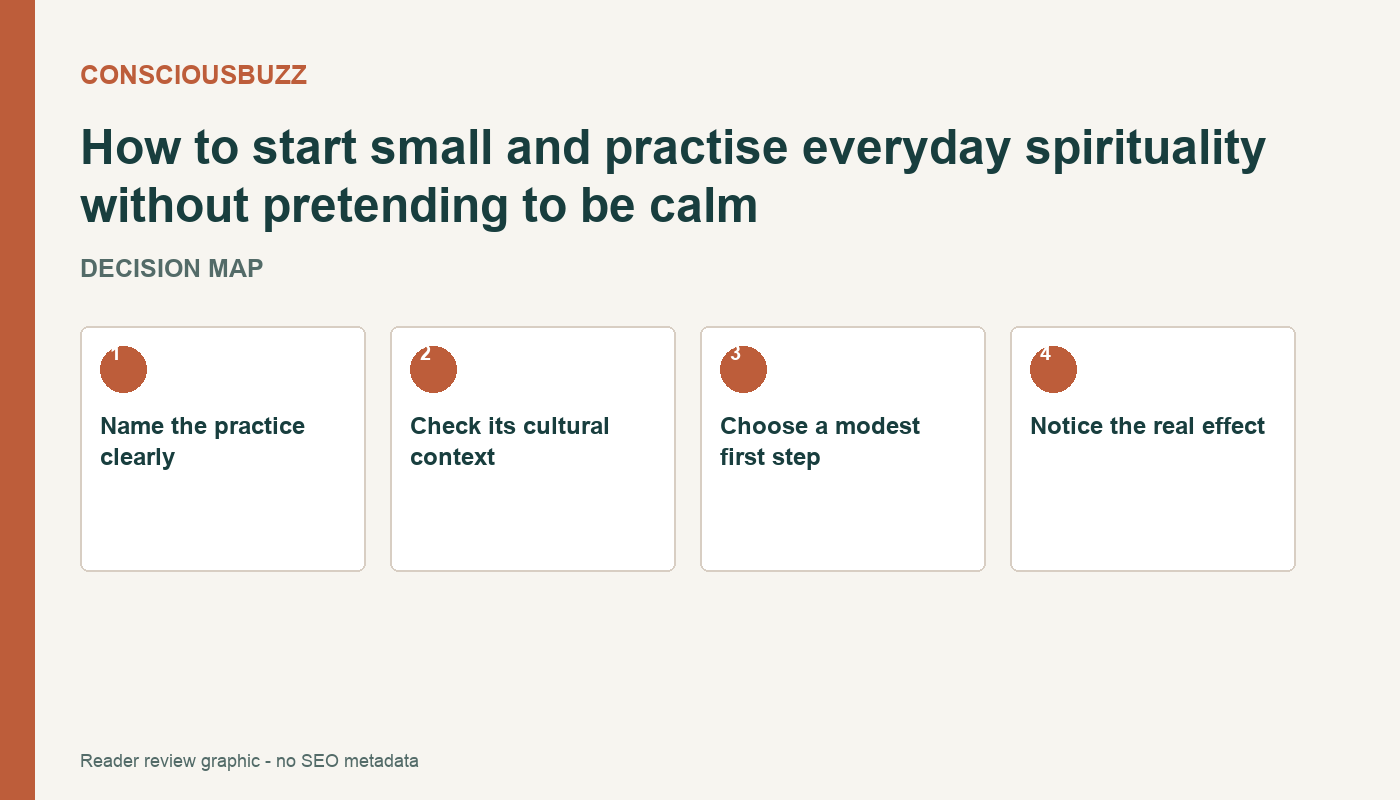
- Notice the trigger: Identify exactly what has caused your emotional response. Did someone interrupt you? Did a policy decision feel unjust?
- Acknowledge the emotion: Silently name the feeling without judgement. Say to yourself, "I am experiencing deep frustration right now."
- Locate the physical sensation: Where does this emotion live in your body? Is your jaw clenched? Is your breathing shallow? Observe the sensation without trying to change it.
- Choose a constructive response: Ask yourself what action aligns with your deeper values. If you value constructive nonviolent activism, choose to step outside for five minutes before re-entering the discussion, or commit to following up with a formal letter rather than arguing in the moment.
Common mistakes when starting a spiritual practice
Beginning a journey into everyday spirituality involves trial and error. Recognising common mistakes early can save you from unnecessary frustration.
Mistake 1: Treating spirituality as an aesthetic Many people fall into the trap of believing they must look a certain way to be spiritual. They might adopt a specific wardrobe, speak in a softer voice, and surround themselves with crystals, while their internal state remains chaotic. Everyday spirituality is about internal alignment, not an external costume.
Mistake 2: Using meditation to suppress anger Some beginners use meditation techniques to push away negative thoughts. If anger arises, they try to meditate it away immediately. True spiritual practice invites you to sit with the anger, understand its root cause, and allow it to pass naturally, rather than forcing it underground.
Mistake 3: Expecting immediate life transformation If you meditate for ten minutes, you will not suddenly become a paragon of patience. Everyday spirituality is a slow, incremental process of rewiring your habitual responses. Expecting immediate results leads to disappointment and abandonment of the practice.
Aligning your wardrobe with spiritual clothing and activism
As your internal practice deepens, you might begin to examine how your external choices reflect your values. This includes the way you dress. Spiritual clothing is not about wearing robes or adopting a specific uniform; it is about choosing garments that align with a mindful, conscious lifestyle.
When you feel grounded in your practice, you may want your external presentation to match your internal reality. You can explore the principles of conscious apparel to understand how clothing choices can reflect a commitment to respectful manufacturing and mindful consumption.
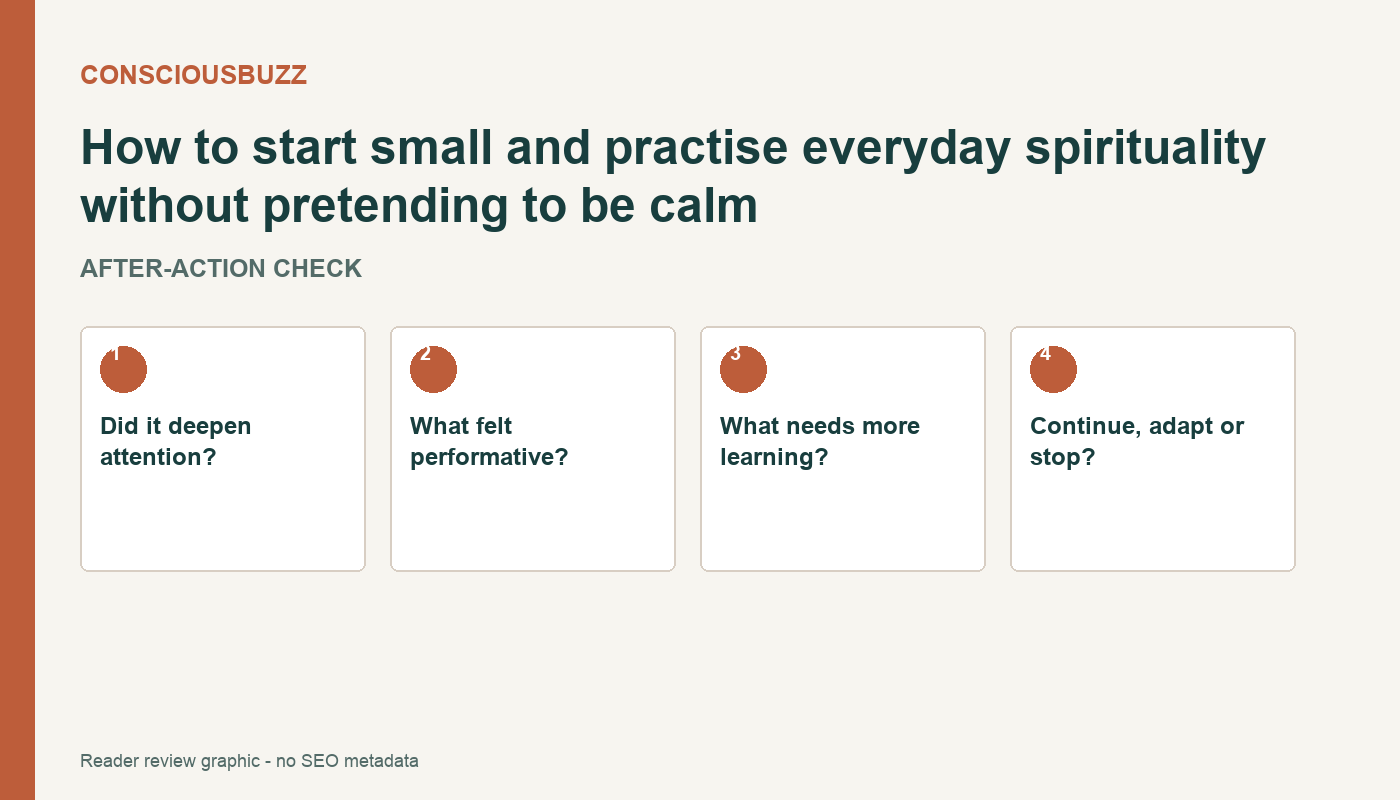
If you are actively involved in community work, your wardrobe can also intersect with your activism. Wearing ethically sourced garments to a protest or a community meeting serves as a quiet, personal statement of your values, rather than a loud aesthetic display. To find brands that prioritise transparent and respectful practices, you might consider researching ethical spiritual clothing brands.
However, remember that the clothing itself is secondary. It is merely a reflection of the conscious choices you are already making. By combining a grounded internal practice with constructive, nonviolent action in your community, you can explore how to merge spirituality and positive action without falling into the trap of performative activism.
Frequently asked questions about everyday spirituality
Is it unspiritual to feel angry about injustice? No, anger is a natural human emotion. Feeling angry about injustice often indicates that your sense of compassion is functioning. Everyday spirituality is not the absence of anger, but the ability to hold that anger without letting it dictate destructive actions.
Do I need to meditate for an hour every day? No. While longer meditation sessions can be beneficial, consistency is more important than duration. Practising mindfulness for five minutes every day will yield better long-term results than meditating for an hour once a month.
How does clothing relate to a spiritual practice? Clothing is a daily necessity. Choosing garments that are made ethically and respectfully is a practical extension of the mindfulness you cultivate on the meditation cushion. It is an external action that reflects an internal commitment to causing less harm.
Dated update note
Updated on 24 October 2023: This article has been reviewed to ensure the practical examples for everyday spirituality and the guidelines on integrating spiritual clothing with activism remain accurate and aligned with ConsciousBuzz’s value-first approach. We have clarified the distinction between performative calm and honest emotional engagement.
If you are ready to move beyond performative calm and build a practice rooted in genuine awareness, join the ConsciousBuzz community. Subscribe to our email list for regular, grounded insights on integrating spirituality, mindful living, and constructive activism into your daily routine.