

Updated September 2026
Turn reflection into one accountable action
Spiritual activism joins inner practice with material work for social change. Reflection should improve how you listen, decide, and stay steady; it should never replace the meeting, donation, testimony, mutual aid, or other action that affected people have said is useful.
Spiritual activism is the practice of grounding public action in inner discipline, so that what you do in the world is steady, nonviolent, and accountable to the people most affected. It is not a replacement for material action; it is a way of doing action without splitting yourself into a performer and a private person. Done well, it turns meditation, prayer, or self-reflection into better timing, clearer demands, and fewer reactive mistakes.
- What spiritual activism actually means
- How inner work supports outer change
- How to avoid spiritual bypassing
- Spiritual activism examples in practice
- Constructive vs. harmful action patterns
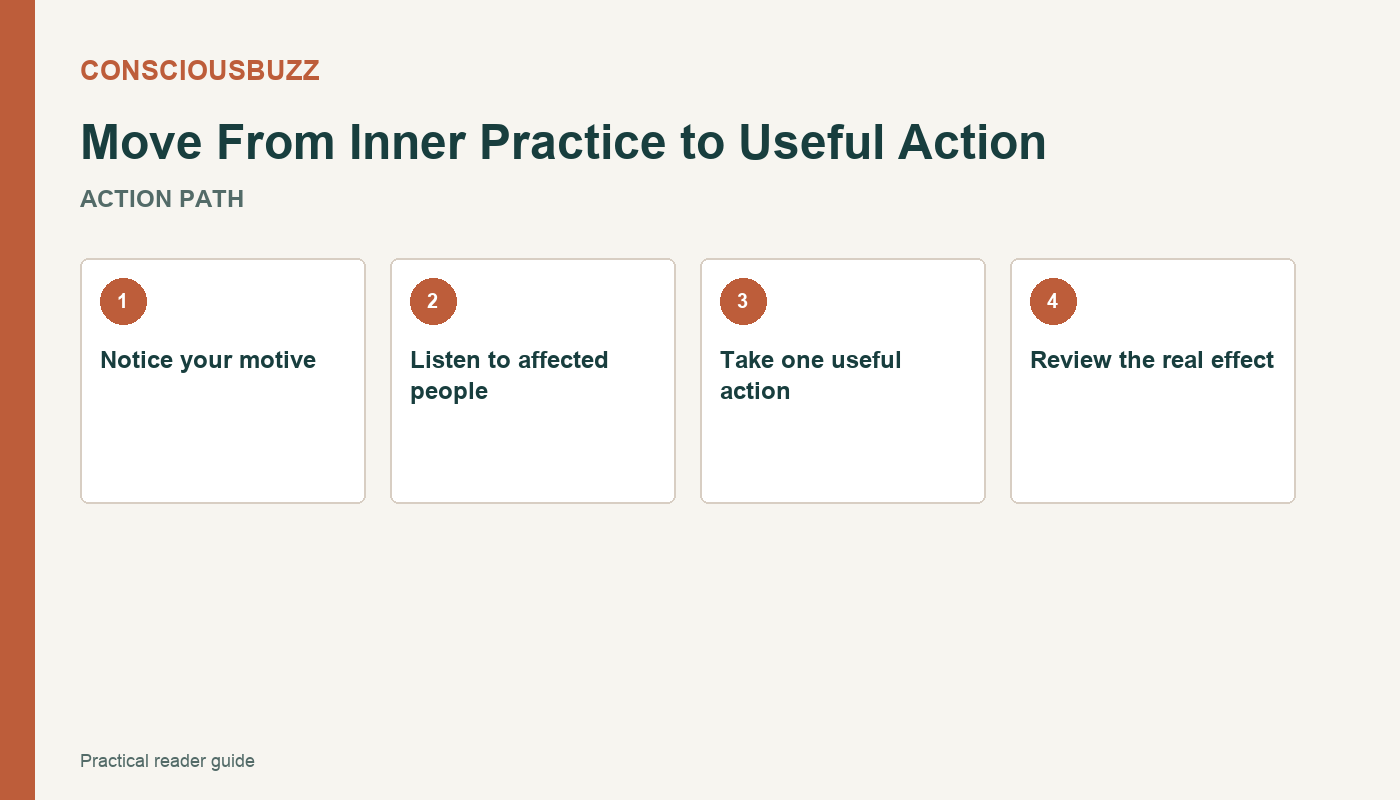
- A decision process before you act
- Common mistakes to watch for
- Why nonviolence is a method, not a vibe
- Accountability to affected people
- Handling anxiety without spiraling or numbing
- FAQ
What spiritual activism actually means
Spiritual activism pairs contemplative practice with concrete public action. The contemplative side is not meant to produce pleasant feelings. It is meant to expose ego, fear, resentment, and the wish to be seen as righteous, so those forces do not end up running your organizing work.
The action side stays material: meetings, budgets, policy demands, mutual aid, defense, testimony, public presence. What changes is the quality. A spiritually rooted activist is less likely to flame out, attack allies, or treat people as props. They are also less likely to confuse intensity of feeling with effectiveness.
This is different from several things it gets confused with. It is not religiosity attached to a cause. It is not using prayer as a substitute for risk. It is not a brand of calm that lets injustice continue. For more on the broader frame of action that stays constructive, see our activism overview.
How inner work supports outer change
Inner practice does four things that make outer action more useful.
- It slows reactivity. You notice the impulse to post, confront, or withdraw, and you can choose whether to follow it.
- It surfaces motive. You see whether you are acting for the affected group or for your own relief.
- It builds capacity for discomfort. Organizing involves long meetings, rejection, and grief. A practice helps you stay in the room.
- It reduces certainty. You stop needing to be the cleanest or smartest person present, which makes coalition work possible.
None of that matters if it stays internal. A person who meditates for an hour and then ignores a tenant eviction is not doing spiritual activism. They are doing spirituality with activism-shaped language nearby. The test is whether the inner work changes what you actually do, how you do it, and who you listen to.
The Unity tradition frames this as a two-step practice: inner realization first, then outer expression that follows from it rather than from reaction. The order matters. When action comes first and reflection is added later as decoration, you get slogans. When reflection comes first and action follows, you get strategy.
How to avoid spiritual bypassing
Spiritual bypassing is using spiritual ideas to avoid facing conflict, grief, or responsibility. In activism it shows up in recognizable shapes.
- “Everything is unfolding as it should” used to avoid organizing against a clear harm.
- “I’m holding them in love” used instead of intervening while someone is being harmed.
- “My work is energetic” used to justify skipping material tasks like showing up, donating, or testifying.
- “Don’t give it negative attention” used to shame people who name a problem out loud.
The antidote is not cynicism. It is sequence. Face the harm accurately first. Then bring whatever practice you use to stay steady inside the work. A reliable test: if your spiritual frame makes you inactive in the face of a child being hurt, it is bypassing. If it makes you more able to intervene well, it is doing its job.
Accountability helps here too. Tell a few people affected by the issue what you are planning and ask whether it sounds useful or evasive. If you cannot name who would check you, you are probably already bypassing.
Spiritual activism examples in practice
Concrete patterns make the abstraction visible. These examples describe ways inner practice and public work can reinforce each other; they are not a claim that every participant uses the label “spiritual activism.”
- Interfaith community work. A faith community can pair prayer or reflection with recurring local work, such as environmental projects or distributing useful material to prisons and hospitals. Unity lists these as examples of its own social-action practice.
- Accompaniment. A trained volunteer can prepare through reflection, then attend a difficult appointment, public meeting, or court date with someone who has asked for support. The practical value is presence and follow-through, not spiritual advice.
- Mutual aid rooted in contemplative community. A meditation or faith community that runs a steady food pantry, transport rota, or emergency fund turns shared values into recurring material support.
- Patient civic work. A group can begin meetings with a short grounding practice, then do ordinary tasks: read a proposal, contact representatives, record decisions, and return the following week.
- Wear your position quietly. Some people express solidarity through fashion as activism in positive solidarity rather than slogan yelling. This works when the clothing points to a real commitment, not when it substitutes for one.
Constructive vs. harmful action patterns
The contrast below is not a morality table. It is a diagnostic. Most activists move between the columns depending on the week.
| Pattern | Constructive spiritual activism | Harmful or performative pattern |
|---|---|---|
| Motivation | Service to affected people; willingness to be unseen | Need to be recognized as morally advanced |
| Timing | Pause, check with affected group, then act | React publicly before understanding the issue |
| Risk | Takes proportionate risk and names it honestly | Performs risk while staying personally safe |
| Conflict | Stays nonviolent and specific about demands | Escalates for emotional release or clout |
| Outsiders | Follows leadership from affected communities | Speaks over the people directly harmed |
| Failure | Names what went wrong and revises | Declares victory or blames sabotage |
| Inner work | Practice feeds stamina and discernment | Practice used to numb distress or avoid tasks |
Use this table on yourself, not on others. Diagnosing other people’s spirituality is exactly the kind of move the table warns against.
A decision process before you act
Before a public action, run these questions honestly. They are slower than posting and far more useful.
- Who is affected? Name the specific group, not “the marginalized” in the abstract.
- Have I heard from them? If not, pause and listen before designing the response.
- What material outcome do I want? Policy, resources, protection, visibility, delay? Be concrete.
- Does my action move toward it? If the link is weak, your action is probably about you.
- What are the costs and who pays them? Include costs to the affected group rather than counting only your own.
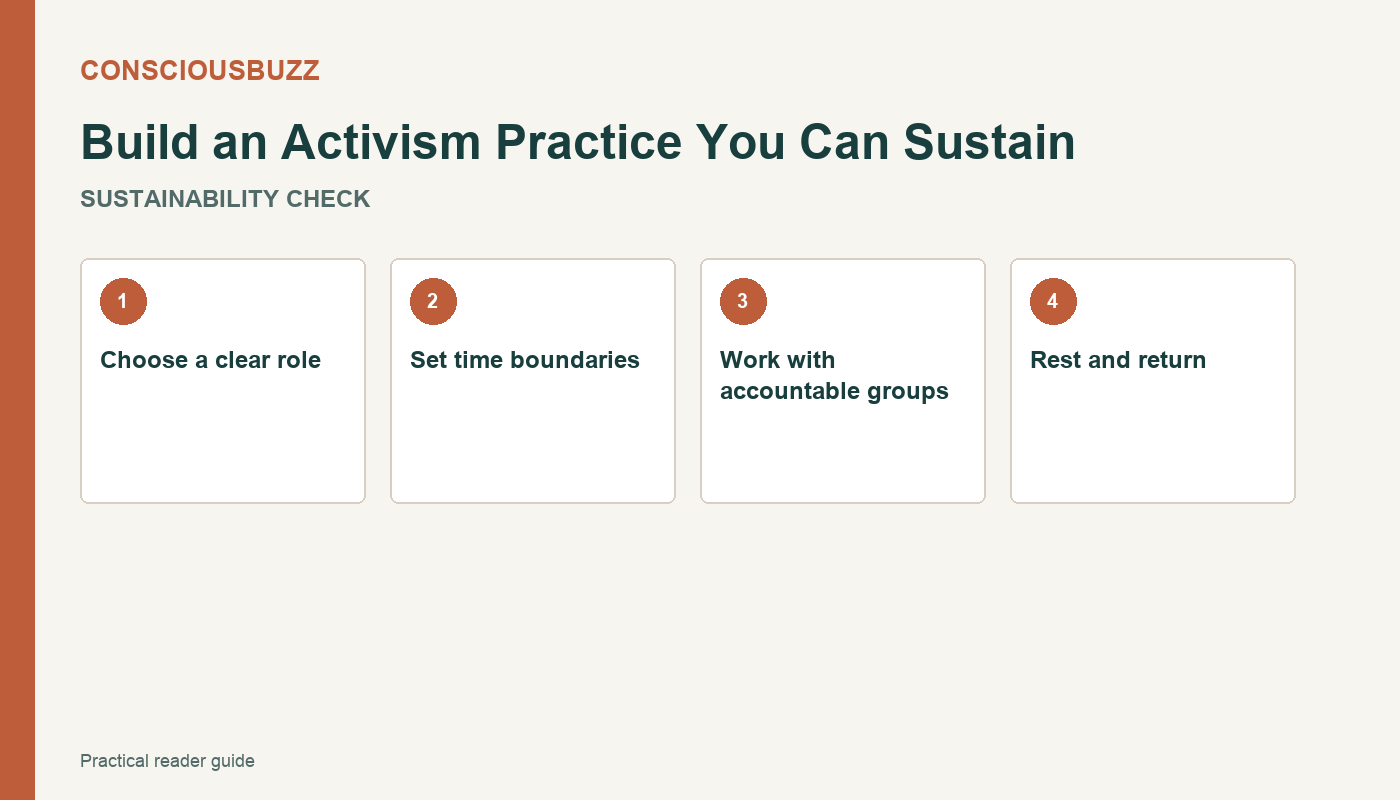
- Can I sustain this? A six-month commitment beats a dramatic week.
- Am I willing to be wrong in public? If not, wait.
If you get stuck on question three, you do not yet have an action. You have a feeling. Spend another day with affected people and with your own practice before deciding.
Common mistakes to watch for
Most failures in spiritual activism are patterned, not original.
- Mistaking calm for wisdom. A quiet tone can still carry a demand that ignores the affected group.
- Using “nonviolence” to police survivors. People directly harmed get to name what safety requires; outsiders do not get to lecture them about anger.
- Spiritualizing burnout. Framing collapse as “surrender” or “release” when what happened is you took on too much alone.
- Confusing presence with impact. Being at every march is not the same as doing the unglamorous work that makes marches matter.
- Choosing causes by identity of messenger. Following only teachers you personally find inspiring rather than issues where your help is actually requested.
- Skipping local accountability. Grand solidarity with distant causes while ignoring neighbors in trouble.
- Treating apparel as the whole act. Activism t-shirts can signal real commitment or cover for inaction; the shirt is a reminder, not the work.
Why nonviolence is a method, not a vibe
Nonviolence in spiritual activism is not the absence of conflict. It is a disciplined method with rules: separate the person from the harm, refuse to humiliate, stay accountable to the people most affected, and be willing to pay a cost rather than pass one on.
This is different from polite silence. Nonviolent method includes public refusal, economic pressure, withholding labor, and direct witness. What it excludes is cruelty dressed as principle. If your action depends on humiliating a specific person in front of their family, it has left nonviolence even if you call it “accountability.”
Nonviolence is also honest about risk. It does not promise safety. It promises that the form of the action will not reproduce the harm you are opposing. That is why spiritual activists who take it seriously train, prepare, and coordinate. They do not improvise heroics.
Accountability to affected people
The single test that separates spiritual activism from performance is accountability to the people most affected by the harm. Everything else, including your practice, bends toward that.
- Find the organizations led by affected people before you design your own response.
- Ask what is actually needed, including boring tasks no one wants.
- Share your plan with at least one person in that group and listen for hesitation.
- Accept feedback without defending your intent.
- Withdraw or change course when asked, even if it feels unfinished.
Accountability does not mean asking affected people to do endless emotional labor for you. It means doing enough relationship work that you can be told you are wrong without the relationship collapsing. If you have no such relationships, start there before you start anything public.
Handling anxiety without spiraling or numbing
Many people arrive at activism through fear. Climate disruption, political violence, economic precarity, and grief for the future all push people toward action, and also toward collapse. The American Psychological Association has documented rising climate anxiety among young people and notes that constructive action, when chosen well, tends to reduce distress more than avoidance does.
The key phrase is “when chosen well.” Reactive, chaotic, or performative action can increase anxiety, because it fails and then feeds helplessness. Spiritual activism offers a structure that makes action sustainable.
- Bound the work. Decide what you will do weekly and monthly, and stop there. Overflowing is not virtue.
- Pair action with practice. Sitting, walking, prayer, or body practice keeps your nervous system from treating every news cycle as an emergency.
- Stay in relationship. Isolated activism amplifies fear. Shared work metabolizes it.
- Name grief. Loss is real. Spiritual bypassing tries to transcend it; good practice lets it move through.
- Accept partial outcomes. You will not fix everything. You will prevent or repair some specific things.
Why community outpaces solo intensity
An individual meditator posting analysis is a weak unit. A small group that practices together and does one recurring material task is a strong unit. Communities catch bypassing that individuals miss in themselves. They also carry work when any one member needs to rest.
Integrating practice and public life
Integration is the part most people skip. They keep spirituality in one room and activism in another, then wonder why both feel hollow. Integration means your practice has public consequences and your public work has interior depth.
Practical integration looks ordinary. It is a five-minute pause before you reply to a difficult email. It is a weekly check with an affected community before you plan the next event. It is refusing to share a headline until you know what the affected group is asking for. It is positive activism apparel worn to a meeting where you actually do work, not instead of it.
The Unity movement describes this kind of integration as a spiritual tool for social action, where prayer and practical involvement are not separate departments but a single movement. You do not need their theology to use the structure.
Clothing as a quiet signal
What you wear can be part of integration. Spiritual clothing that reflects values can serve as a reminder to yourself and a low-pressure signal to others. It fails when it becomes the whole act. It works when it accompanies recurring material commitment.
FAQ
Is spiritual activism religious?
It can be, but it does not have to be. Many people practice it through secular contemplation, somatic work, or simply structured honesty about motive. The core is discipline and accountability, not doctrine.
Does inner work excuse doing less in public?
No. If your practice reduces your material action, it has become avoidance. Real practice increases your capacity to act well and consistently.
Can spiritual activism include confrontation?
Yes. Nonviolence is not passivity. It includes firm demands, refusal, witness, and pressure. The line is whether your method reproduces the cruelty you oppose.
How do I start without being performative?
Start by listening to affected people, take one recurring material task, and tell as few people as possible until it is a habit. Let the practice be invisible for a while.
What if I disagree with leaders in the affected community?
Disagreement is normal. Say so directly, to them, and accept the consequences. Do not bypass them by appealing to a higher spiritual truth that conveniently agrees with you.
Is wearing values on clothing spiritual activism?
Only when paired with action. Clothing can be a useful reminder and signal, but by itself it is expression, not activism.
Turn your reflection into steady, accountable action
ConsciousBuzz exists to help people do exactly this: move inner practice into constructive, nonviolent, accountable public work. If you are building a habit of positive activism, start with the material tasks you can sustain, and let your practice support them rather than replace them. Explore our activism resources for practical structures, and consider positive activism apparel that reminds you of commitments you are already keeping. Reflection is the seed. Action is the plant. Accountability is the soil. All three are required.